

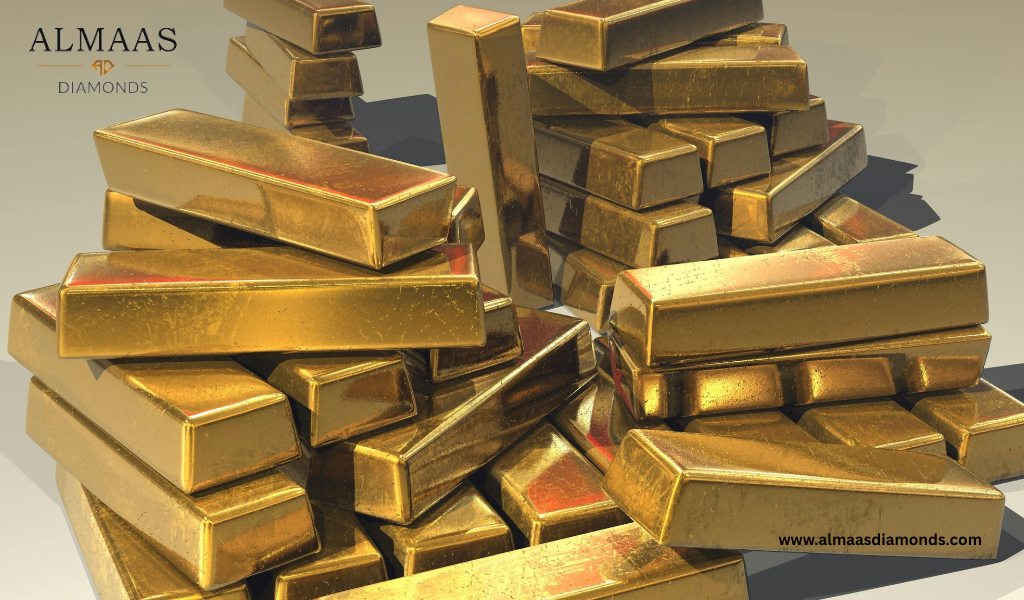

It’s a fair question. If we can produce diamonds in the lab, can gold not be created that way too? Or is “lab-grown gold” just a marketing phrase?
What Is Gold, Exactly?
Gold is a natural chemical element with the symbol Au. Diamonds are made of carbon atoms arranged in a particular, repeating pattern, while gold is a metal that occurs as a pure element in the Earth’s crust.Since gold is an element, it cannot be “grown” in the fashion of diamonds. Lab-grown diamonds are produced by mimicking the natural environment where diamonds grow. However, gold is not formed through crystal growth like that. It is a metallic element formed during cosmic processes like supernova explosions billions of years ago.
And that’s why “growing” gold in a lab isn’t as simple as it sounds.
Read More Blog: The Perfect Wedding Necklace For Every Bride
Is It Possible to Create Gold in a Laboratory?
Yes, in theory — but not in a practical or commercial sense.Through a complex process called nuclear transmutation, scientists have been able to manufacture tiny amounts of gold. More specifically, this is about transforming the atomic structure of another element into that of gold in particle accelerators or via nuclear reactions.
However, this process:
- Produces extremely small quantities
- Requires highly advanced scientific equipment
- It costs, well, significantly more than the gold produced.
So technically it is possible to produce gold in a laboratory, but there exists no way for such a product to exist in the jewellery market.
So What Is “Lab-Grown Gold” Exactly?
When you read the phrase “lab-grown gold” in the context of jewellery, it usually does not refer to freshly minted gold atoms.Instead, it typically refers to:
Recycled Gold
What is recycled gold? Recycled gold is refined and reused gold extracted from existing pieces such as jewellery, electronics, or industrial sources. It is then melted, purified and refashioned into new pieces of jewellery.
Recycled gold is chemically the same as newly mined gold. Once refined, there is literally no difference at all in quality or durability or value.
Refined Gold Processed in Laboratories
Others use the phrase “lab-grown" to indicate that the gold has been processed and refined in controlled laboratory settings rather than freshly mined.
In these instances, the gold itself hasn’t been newly created — it has simply been refined and reused.
Why Is the Term Gaining Popularity?
Lab-grown diamonds have changed the way people see sustainability in jewellery. Will consumers who are increasingly environmentally conscious want alternatives to traditional mining?Gold mining can have a massive environmental impact, such as:
- Land disruption
- Water pollution
- High energy consumption
It’s crucial that consumers understand this difference.
How is Lab-Grown Gold Different from Mined Gold?
Chemically and physically, no.Gold is gold. When refined to a particular purity (e.g., 18 ct or 24 ct), it is intrinsically the same no matter where it comes from.
There is no visual, structural or performance difference between:
- Newly mined gold
- Recycled gold
- Laboratory-refined gold
- Purity (carat level)
- Weight
- Current market price
How Is Gold Refined and Purified?
Whether coming from newly mined gold or recycled, the metal must be refined to remove impurities. This often includes methods for melting and chemical purification that guarantee the metal is at a required purity level.After refining, gold can further be alloyed with some other metals to produce:
- Yellow gold
- White gold
- Rose gold
But the refining process doesn't produce new gold. It simply purifies existing gold.
What’s so confusing about lab-grown diamonds?
Most of the confusion centres around the emergence of lab-grown diamonds.Lab-grown diamonds are real diamonds. These lab-grown gems are made with devices that mimic conditions for natural formation. Their physical, chemical, and optical properties are the same as those of mined diamonds.
Because this type of thinking went mainstream, some investors believed that the same could happen in gold.
But gold is fundamentally different. It is not a compound that we can harvest into crystal under controlled conditions.
That’s why the comparison doesn’t entirely hold.
Is “Lab-Grown Gold” Misleading?
Not necessarily — but it can be misinterpreted.If a brand uses the term to refer to recycled or sustainably refined gold, it typically means that they are focusing on environmental responsibility.
But it’s always prudent to ask:
- Is the gold recycled?
- What is its purity?
- Is it certified?
Transparency is key.
Should You Choose Recycled Gold?
If you care about sustainability, recycled gold is a great option.Benefits include:
- Reduced environmental impact
- Lower demand for new mining
- Same quality and durability as mined gold
Bottom Line: Is Lab-Grown Gold Real?
Here is the simple answer:It is technically possible to create gold in a lab using nuclear science, but not in a tangible or economical way.
Since “lab-grown gold” in jewellery typically refers to recycled or refined gold.
Recycled gold is 100% genuine gold, and in every aspect that matters, it’s the same as the gold dug out of the Earth.
So if you see the term “lab-grown gold", realise this does not mean newly created gold atoms. Usually, it refers to responsibly sourced or recycled gold made in controlled environments.